Campaign Strategy Plan
The Campaign Strategy Plan is the overall planning document that informs the overall voter engagement strategy, roles and responsibilities of staff and vendors, and outlines how the campaign will execute day-to-day.

The Campaign Strategy Plan is made up of five core, integrated components. The purpose of the Campaign Strategy Plan is to provide an operational framework that clearly outlines roles and responsibilities, budget by functional area (field, voter engagement, admin, etc.), and sets forth the Execution Roadmap.
At Third Coast Strategies, we believe success starts with having a comprehensive plan. During the course of the campaign there will be times when it is necessary to pivot but the Campaign Strategy Plan provides the working framework to ensure the campaign is nimble, agile, and can respond in real time to new and emerging issues/challenges.
Keep reading to learn more about each of the five Core Components!
Core Component #1:
Campaign Guiding Principles
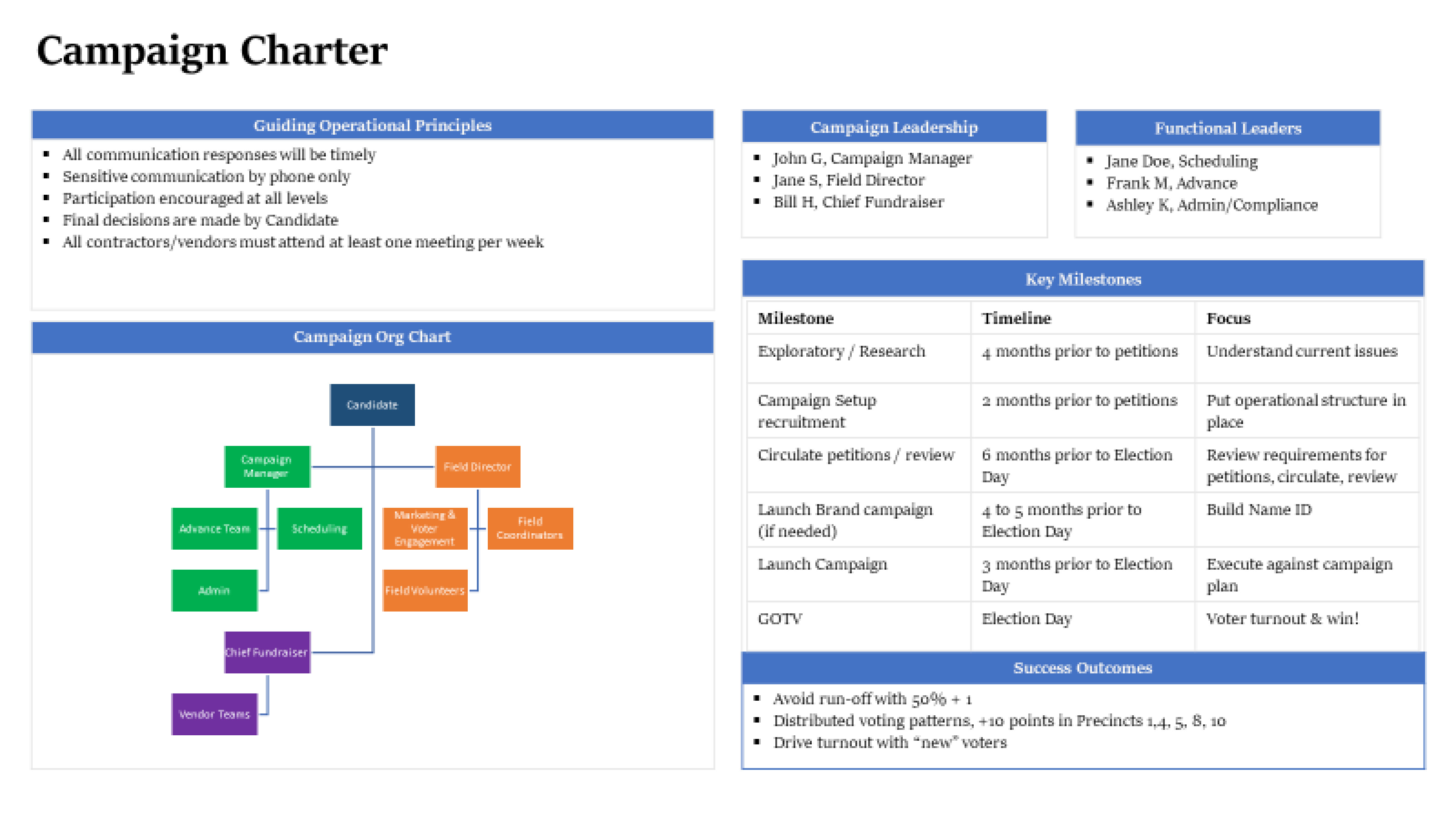
The Campaign should establish guiding principles for how staff, vendors, and volunteers are expected to work together. The main output is a Campaign Charter which outlines the main components of the campaign, org chart, key milestones, and success criteria.
Core Component #2:
Roles and Responsibilities
The corporate world has long leveraged the power of decision making models. Decision making models are powerful tools and effective for flawless execution because they clarify authority and accountability. Big 3 Management Consultancy Bain uses the RAPID model. Other popular models are RACI. Regardless of the model the key objective is the same: to clarify who has decision making authority and over what area.
The key deliverable is a simple table that leverages the RAPID and RACI principles.
There are three focus areas:
- Responsible. Generally a single person or department is responsible for delivering the outcome. They perform the task.
- Infom. Parties that need to be informed on progress and should be aligned to the direction.
- Decide. Generally one person or department and this party is the ultimate decision maker. They decide the direction and resolve any intra-party disputes.
Decision making models are critical for success. The candidate should determine the appropriate model, fully endorse it, and communicate it to the entire campaign. Generally, Campaign Managers have full decision making authority; however, there may be instances where the Field Director has full decision making authority over field operations. Unless this is known and agreed upfront this can cause friction during the campaign and impede decision making.
It is also critical to define what the core functions are within each area. For example, does the Campaign Manager have final approval over how the budget is allocated? Does Field include digital voter engagement or does that sit with a different Senior Staff Member? These are critical questions that, if answered up-front and discussed openly with all stakeholders, will eliminate friction and pave the way for a winning campaign!
Campaign Staffer | Campaign Strategy | Field Operations | Volunteer Coordinator | Vendor Management |
John G (Campaign Manager) | Decide | Inform | Decide | Decide |
Jane S (Field Director) | Responsible | Decide | Inform | Inform |
Diane F (Field Coordinator) | Inform | Responsible | Inform | Responsible |
Mike T (Volunteer Coordinator) | Inform | Inform | Responsible | Inform |
Bill B (Creative Director) | Inform | Responsible | Inform | Inform |
Core Component #3:
District Overview
The district overview is a critical component because the content directly influences Voter Personas, which segments voters and/or helps inform sub-campaigns. For example, “crime” may mean vandalism to certain voters while other voters may be concerned with more serious crime. Likewise, “efficient city services” can mean lowering fees and expenses for fixed income voters or it may mean consolidating offices to save money. Regardless, a comprehensive district overview – which should also include a poll (resources permitting) – will provide the foundation for how to engage with voters.
Creating relevant voter personas is essential for a winning campaign. The Voter Personas Table is required to finalize Voter Message Mapping (Part II of this series), which provides the framework for overall voter engagement and mobilization strategies. The Voter Personas Table also helps organize the campaign’s focus and generally has seven key areas:

Core Component #4:
Campaign Budget
The overall campaign budget will contain line items for staff, external consultants, overhead, promotional items, and general expenses to run the campaign, i.e., food, transportation, etc. While there is no “standard” in terms of what percentage should be spent on voter engagement the fact is that care should be taken to allocate as much of the overall budget to reaching voters. A reasonable range for voter engagement activities would be between 70% and 85% of the overall budget. This means that a $100,000 campaign budget would spend between $70,000 and $85,000 on reaching voters through any combination of channels (i.e., Cable TV, direct mail, YouTube, Google, radio, Billboards, etc.). The overall mix of voter engagement dollars into any one channel is a decision made on the basis of name recognition, district size, voter demographics, national and/or regional political issues, etc.
Establishing a flexible budget at the onset is often overlooked but it is critical for success. The overall budget informs the Fundraising Plan since the budget “backs into” a fundraising goal. The other benefit is to plan voter engagement campaigns around a flexible budget. In the example table below, the campaign determined seven campaigns across three unique voter personas are needed and the budget can be applied to each campaign.
Key Issue #1 Public Safety | Key Issue #2 Improve Government Services | Key Issue #3 Drive Economic Development | |
# of Campaigns | 4 | 2 | 1 |
Campaign Type & Voter Persona (VP - from Voter Persona table above) | 1. General “X-Point” Crime Reduction Plan (VP1,2,3) | 1. Reduce “Red Tape” (VP1,2,3) | 1. Small business task force (VP2,3) |
Channel Strategy | Cable TV (1,2,3) Digital (YouTube/FB) (4) Direct Mail (1,2 for VP3 only) | Cable TV (1,2) Digital (YouTube/FB) (1,2) Direct Mail (1,2) | Digital (YouTube/FB) (1) Direct Mail (1) |
Messaging Considerations | New Police Council to use neutral language
| Strong language for both campaigns
| Positive, upbeat and data-driven language on benefits of economic development |
Budget | Total = $150K General “X-Point” Crime Reduction Plan VP1 = $10K VP2 = $15K VP3 = $35K New Police Council VP1 = $15K VP2 = $15K VP3 = $35K Carjacking VP2 = $15K Assaults VP1 = $10K Totals VP1 = $35K VP2 = $45K VP3 = $70K Total = $150K | Total = $100K Reduce “Red Tape” VP1 = $15K VP2 = $10K VP3 = $30K Structural Budget Deficit VP2 = $10K VP3 = $35K Totals VP1 = $15K VP2 = $20K VP3 = $65K Total = $100K | Total = $25K Small Business Task Force VP2 = $10K VP3 = $15K Totals VP2 = $10K VP3 = $15K Total = $25K |
Sequencing | 1, 2 to launch 10 weeks prior to Election Day 3, 4 to launch 8 weeks prior to Election Day | 1, 2 to launch 12 weeks prior to Election Day | 1 to launch 8 weeks prior to Election Day |
Core Component #5:
Timeline
The rise in early voting and vote by mail mean that knowing your voters is not enough. Examining the early voters and vote by mail timelines will ensure that the campaign is sending materials and launching voter campaigns well in advance of when voters will receive ballots or are eligible to vote at early voting locations. It is also necessary to draft a week-by-week calendar that outlines the candidate’s schedule (i.e., fundraising, events, etc.) as well as key milestones for direct mail drops, TV buys, digital campaigns, and other voter engagement activities. From here a sub-milestone calendar can be created that outlines the activities and responsibilities necessary for completing those key milestones/deliverables. For example, if the campaign wants to launch a key commercial on Feb 1 then script drafting, review, pictures, filming, editing, etc. will mean work needs to begin in December. A campaign timeline is not fixed. There will be deviations and what is needed and when will change; however, establishing a framework that unites voter engagement activities and staff/consultant responsibilities will provide a common pathway to winning.
Spending the time upfront to establish and document a master campaign plan is not a nice to have, but a must have for the campaign to win. The budget and voter engagement strategy are two critical elements that are foundational and must be outlined before the campaign can launch. The voter engagement strategy should be designed based on the budget but also should consider additional factors like, how well known the candidate is and broader macro level trends that may influence voter turnout.
For example, a new candidate or a candidate with relatively low name recognition would benefit from the mere exposure effect, a psychological phenomenon by which people tend to develop a preference for things or people that are more familiar to them than others. The research on mere exposure effect is well-documented, spanning over fifty years and widely used in B2C and B2B marketing. The research over the past half century also concludes that there are diminishing returns, with optimal exposure at around twenty.
Putting It All Together
A Campaign Strategy Plan also organizes the key activities and deliverables of staff. By defining roles and responsibilities, a budget, a timeline and a comprehensive overview of the district and the electoral dynamics the campaign can set the foundation for successful and flawless execution. A winning campaign starts with a plan.
Third Coast has created hundreds of Campaign Strategy Plans for candidates at all layers of government. The overall engagement strategy (i.e. the mix of dollars spent on Cable TV, direct mail, radio, digital strategy, etc.) is outlined up-front and the key messages that will best resonate with voters are mapped to those channels. The Campaign Master Plan sets the foundation for the next step in the Third Coast Approach Framework, which is Voter Message Mapping.